Thought for a lifetime

Einstein made the very important observation that " Imagination is more important than knowledge ".

Wednesday, February 12, 2014

California Fibers


Soka University in Aliso Viejo is a giant, sprawling campus boasting some amazing architecture.

www.californiafibers.com

And from January 13 until May 8, 2014 Soka University is hosting a free exhibit in the Founders Hall Art Gallery of 66 original works of art by 22 members of California Fibers. 

Julie Kornblum surplus yarn, plastic bags
 The artworks range from very large to very small and from traditional to avant garde.

Kathy Nida
The level of skill in all the works is very impressive.

Susan Hart Henegar, tapestry

A photo never does justice to scale and textures. 
These tapestries and the recycled quilt are about 5' X 7'.

Susan Henry, recycled mens wool trousers and suit jackets


Vayla, felted and quilted

Polly Jacobs Giacchina, date palm, caning and raffia
 There are numerous three dimensional pieces that are very organic in shape.

Gail Fraser, hand twined with wax linen, reed, sisal, wire and ceramics

Lydia Tjioe Hall, steel wire, cast bronze, waxed linen thread

Lynne Hodgman, crocheted rayon thread

This is a very large installation and very effective for its' relative simlpicity.


Ashley V. Blalock, cotton yarn
And I will conclude with one of my favorite pieces; 
an old school skill of crochet taken to an artistic level with a giant floor to ceiling installation.

Many people possess skills that they think are quite ordinary when in actuality the only limit to the skill is their imagination.
This exhibit celebrates and explores the ancient skill of working with fibers in many new and innovative ways.

Friday, January 31, 2014

Wayne Wichern; Milliner Extraordinaire


WAYNE WICHERN

www.waynewichernmillinery.com

Wayne sharing his knowledge and supplies during hat workshop

After my fabulous experience at Hat Camp 
( see blog entry dated 10/3 2013 Destination: Hat Camp )
I was determined to attend one of Wayne Wichern's Hat Workshops in Burlingame. 

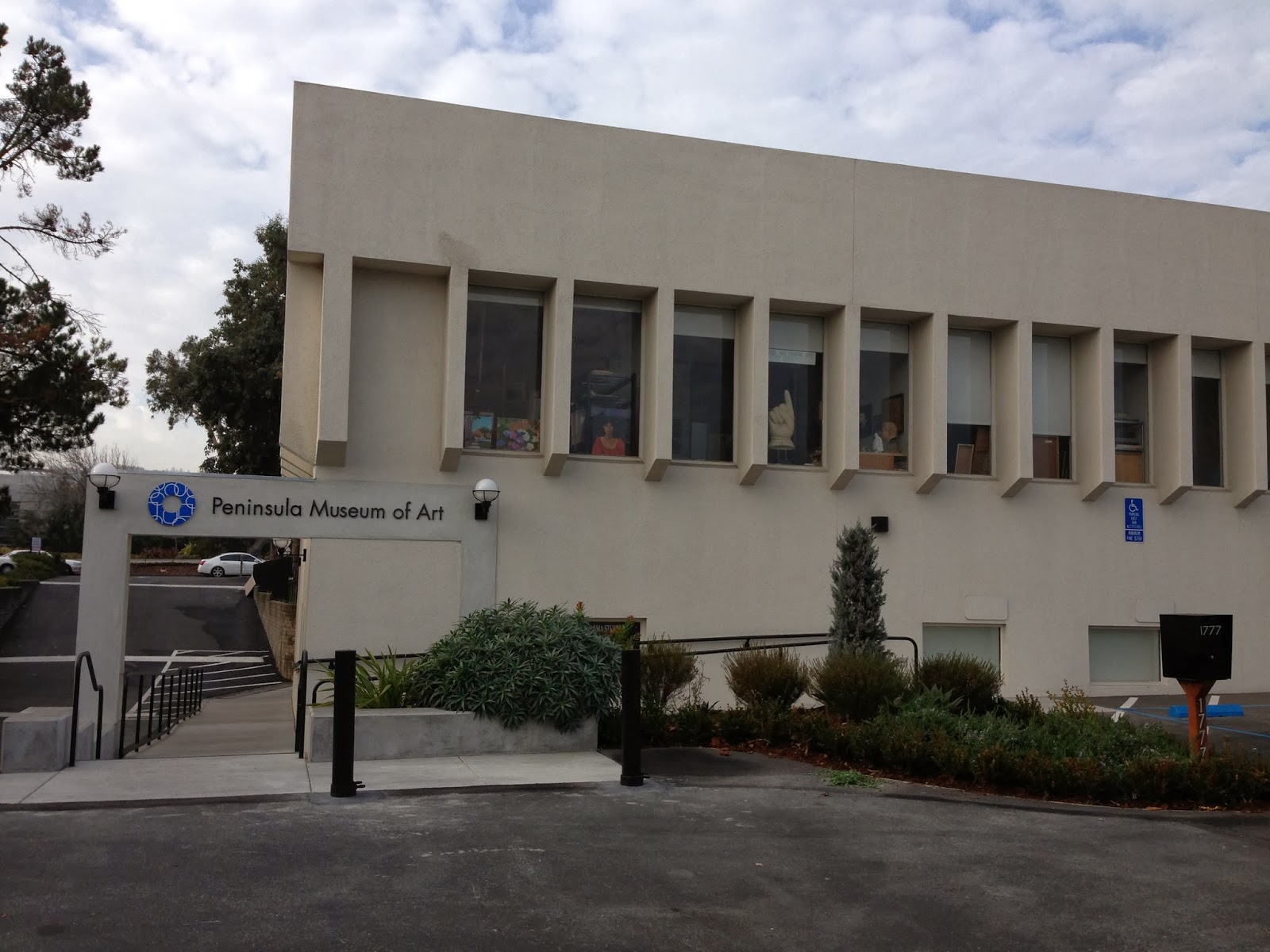
Wayne Wichern Millinery is at 1777 California Drive, Studio 7 & 8, Burlingame, CA 94010

Lucky for me Wayne's studio at the Peninsula Museum of Art was just a bus and BART ride away from my girlie's apartment in San Francisco.


Since the goal of the workshop is to learn how to block hats
 on wooden forms ( called hat blocks )


and the fact that there are probably 200+ ( 300+ ? ) hat blocks in Wayne's studio


I knew immediately the workshop was going to be incredibly informative.
And I wasn't disappointed.


The first demonstration was a straw hood ( or blank ) blocked on this hat block.


Wayne explained all the different types of straw, the good and not so good, the weave, and the preparation of the straw, etc.


It takes a lot of  strength to block a hat and 
agility to slip a string around the stretched straw to hold it in place.


After the hat dried the excess was cut away


The brim was clean finished on the sewing machine


and then Wayne shared his method for creating a headband and sewing it in place.


Then the steps were repeated with a wool felt that was blocked,


left to dry,


and some subtle variations in the finishing steps.
I am being extremely brief! 
Eight pages of hand written notes attest to
 the knowledge and impressive skills Wayne so very generously shared with us.


All around Wayne's studio were wonderful hats in all shapes, colors and trims that were so inspiring!


Wayne has been a milliner for 27 years and is a true master of his trade.
As I begin my millinery journey with no clear destination 
it truly humbles me to have someone so unselfishly share decades of experience.

Three Days in Hat Heaven


" A great hat speaks for itself " 
( author unknown )

Created in Wayne Wichern's Hat Workshop www.waynewichernmillinery.com

At the end of three days and 21 hours of dedicated hat making
 I completed four original hats.


Step 1 was the very difficult selection of what color wool felt hood ( hat blank ) 
AND what wooden block from the 100+ blocks…


Step 2 was even more difficult to actually stretch the hood snugly over the block 
when you are a weakling like me !


Steam the heck out of it…


Pull, tug, stretch, steam, tie off the crown with string, 
pull, tug, stretch, steam, tie a string below the brim to hold the shape.


Then let the steamed, stretched, strung up felt dry.


Repeat with a new hood and block...


 and one more time with a beautiful fur velvet.


I also blocked a straw and getting the top flat was beyond a challenge.


Once the hats were dry they were oh so gingerly removed from the blocks. 
Some of the blocks are 'puzzle' blocks that come apart so removal is easier.


After cutting away the excess material the edge of the brims were finished by machine sewing.


This hat has a very challenging interior pleat that must be sewn without wrecking the shape.


Next sewing challenge; putting in the headband to reinforce the shape 
and help prevent distortion during the lifetime of the hat.


Finally the last step of trimming the hat.
A simple task compared to creating the hat but, almost more important!


This hat was named the Rally hat by my fellow students because
 my ribbon trim resembled a road and I said I wanted to glue on a little car :)


Wayne is a master at creating these maple leaves from the cut off excess felt of the hat.
Simple and elegant.


The asymmetrical brim on my straw hat really needed something big but, 
this trim is just tacked on so I can continue figuring it out 


The biggest test of my hats was if my girlies liked them or laughed…
Success! They loved them and even asked if they could have one.


However I am still in the honeymoon stage with my newest chapeaus 
and immensely enjoying wearing them out and about
so I am keeping every one.


I love any reason to go to San Francisco,
but, my three days in hat heaven ranks as one of my best trips EVER!